
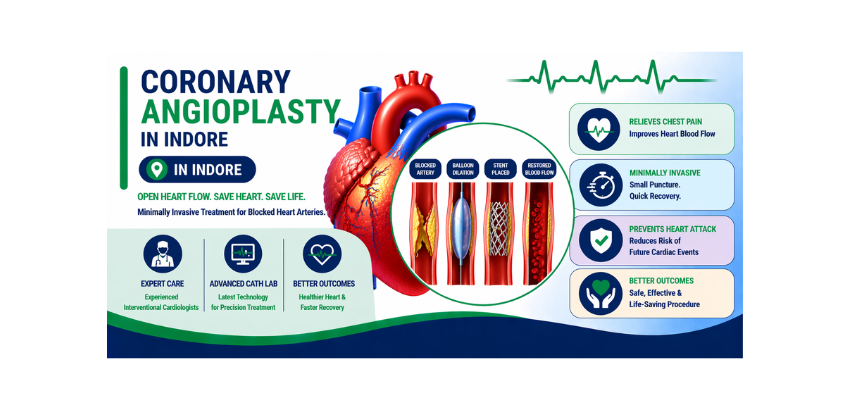
Coronary Angioplasty & Stenting in Indore
Minimally invasive treatment to open blocked heart arteries — balloon angioplasty and drug-eluting stents, performed through the wrist (radial access) by Dr. Paritosh Kumar Rajput, interventional cardiologist in Indore.
Coronary angioplasty — also called percutaneous coronary intervention (PCI) — is a minimally invasive procedure that opens narrowed or blocked coronary arteries, restoring blood flow to the heart muscle. A soft catheter is guided to the blockage, a small balloon widens the artery, and a drug-eluting stent is placed to hold it open. Because it needs no chest incision, most patients recover far faster than with open surgery. For patients across Indore and the wider Malwa region, it is one of the most common and effective treatments for coronary artery disease and heart attack.
When is coronary angioplasty needed?
Your cardiologist may recommend angioplasty when a coronary artery is significantly narrowed or blocked and is causing symptoms or putting the heart at risk. Common reasons include:
- Angina — chest pain, tightness or pressure, often on exertion
- Breathlessness or reduced exercise capacity from restricted blood flow
- Heart attack (STEMI/NSTEMI) — where emergency angioplasty can be life-saving
- A significant blockage found on a stress test, CT coronary angiogram or coronary angiography
- Symptoms that persist despite medication
If you experience severe, crushing chest pain, pain spreading to the arm or jaw, sweating or breathlessness, treat it as an emergency and seek immediate care — do not wait.
Types of angioplasty we perform
- Balloon angioplasty with drug-eluting stenting — the standard treatment for most blockages.
- Radial (wrist) angioplasty — access through the wrist rather than the groin, which means less bleeding, less discomfort and faster mobilisation.
- Primary angioplasty (primary PCI) — emergency, time-critical treatment during an active heart attack.
- Complex & high-risk PCI — for chronic total occlusions (CTO), left-main, bifurcation and heavily calcified arteries, often supported by advanced imaging.
- Imaging- and physiology-guided PCI — IVUS/OCT imaging and FFR/iFR pressure measurement to place stents precisely and confirm which blockages truly need treatment.
What happens during the procedure — step by step
- Preparation: blood tests, ECG and coronary angiography identify the exact site of the blockage.
- Local anaesthesia: the wrist (or groin) is numbed; you remain awake and comfortable.
- Catheter placement: a thin catheter is guided to the coronary artery using live X-ray.
- Opening the artery: a balloon is inflated at the narrowing to widen it.
- Stenting: a drug-eluting stent is deployed to keep the artery open long-term.
- Completion: the catheter is removed and the small puncture is sealed. A simple case typically takes 30–60 minutes.
Recovery after angioplasty
Recovery is usually quick, especially with the radial approach. Many patients walk within a few hours and are discharged within 24 hours. Light activity resumes within days; heavy lifting and strenuous exercise are avoided for a short period on your cardiologist's advice. Two things matter most for a lasting result:
- Medication adherence — dual antiplatelet therapy (usually aspirin plus a second blood thinner) protects the stent. Never stop these without medical advice.
- Lifestyle — a heart-healthy diet, no smoking, regular activity, and control of blood pressure, cholesterol and diabetes.
Is angioplasty safe? Understanding the risks
Coronary angioplasty is a well-established, generally very safe procedure performed thousands of times a day worldwide. As with any medical procedure there are small risks — bleeding at the puncture site, artery injury, irregular heartbeat, a reaction to the contrast dye, or re-narrowing of the artery (restenosis). Drug-eluting stents have sharply reduced restenosis, and radial access reduces bleeding risk. Your cardiologist will explain the specific risks in your case before the procedure.
Angioplasty vs bypass surgery (CABG)
Angioplasty is minimally invasive with a much shorter recovery, and is often ideal for single- or double-vessel disease. Bypass surgery may be preferred for complex multi-vessel disease or certain patients with diabetes. The right choice is made individually after reviewing your angiography — sometimes with a "Heart Team" discussion — so the plan fits your specific anatomy and health.
Cost of angioplasty in Indore
The cost of coronary angioplasty in Indore depends on the number and type of stents used, the complexity of the blockage, and the hospital. Many cases are covered under Ayushman Bharat and cashless insurance/TPA schemes. For a current, personalised estimate and help with insurance approvals, call the clinic on +91 62647 63216. [Practice note: add your specific package ranges and empanelled insurers here.]
Why choose Dr. Paritosh Kumar Rajput for angioplasty in Indore
- 13+ years of experience in interventional cardiology
- 10,000+ cardiac procedures performed
- Radial-first approach for less pain and faster recovery
- Practice aligned with ESC & ACC international guidelines
- Based at Choithram Hospital & Research Centre — a leading cardiac centre in Indore
- Trusted by patients travelling from Ujjain, Dewas, Ratlam, Mandsaur, Dhar, Mhow, Pithampur and across Malwa
Serving Indore & the Malwa region
Patients from across central Madhya Pradesh choose the clinic for coronary angioplasty because advanced interventional cardiology and emergency primary PCI are available locally, without travelling to a metro city. Whether you are in Indore itself or coming from Ujjain, Dewas, Ratlam or a nearby town, the team can arrange timely assessment, angiography and treatment.
Frequently asked questions
Is coronary angioplasty a major surgery?
No. It is minimally invasive — there is no chest incision. It is done through a small wrist or groin puncture under local anaesthesia while you stay awake.
How long does it take and how long will I stay in hospital?
A simple angioplasty takes about 30–60 minutes. With the radial route, many patients go home within 24 hours.
Is the procedure painful?
It is done under local anaesthesia, so most people feel only a small prick and some mild pressure when the balloon is inflated.
How long do heart stents last?
Stents are permanent. Drug-eluting stents greatly reduce re-narrowing; long-term results depend on your medicines and lifestyle.
Can angioplasty be done during a heart attack?
Yes — primary angioplasty is the gold-standard emergency treatment for a heart attack and is time-critical. Seek care immediately for severe chest pain.
Do I need medicines afterwards?
Yes — dual antiplatelet therapy and other heart medicines. Do not stop them without your cardiologist's advice.
Medically reviewed by Dr. Paritosh Kumar Rajput, MD, DM (Cardiology). This page is for patient education and is not a substitute for professional medical advice. Please consult a qualified cardiologist for guidance specific to your condition.